Traceable gold brand targets growth after deal with net zero mine
Featured

An initiative aimed at providing responsibly-sourced, traceable gold is targeting further expansion after partnering with the world’s first net zero gold mine.Charlie Betts, co-founder of the Single Mine Origin (SMO) brand, says it has built up stock from the Bellevue Gold Project in Western Australia and now has “very significant amounts” to supply to jewellers.Early customers for this gold include Messika, with which SMO is conducting scale trials. “Our dialogue with them is that [it] will escalate pretty rapidly and increase throughout this year,” says Betts, adding that he expects the French brand, which has a global retail network, to become SMO’s biggest jeweller client by the end of 2026 “unless we land a giant”.Betts, managing director of UK refiner and bullion dealer the Betts Group, launched SMO with his brother, Dan, then head of gold producer Hummingbird Resources, in 2017. Now wholly owned by Betts Group, SMO supplies gold that is tracked from a member mine, which must adhere to the World Gold Council’s Responsible Gold Mining Principles or an equivalent standard, to a jeweller. The gold is refined in segregation at a LBMA certified refinery, with SMO sending independent auditors to confirm batches are kept separate.The scheme’s fourth and newest member mine, the Bellevue Gold Project, announced in August that it had become the world’s first net zero gold mine. The mine, where production began in October 2023, achieved net zero greenhouse gas emissions (Scope 1 and Scope 2) for the first half of last year, according to Bellevue Gold’s annual report.The mine has on-site wind turbines and a solar farm, along with a renewable energy power station. Darren Stralow, managing director and chief executive of Bellevue Gold, says there has been a period of more than 100 consecutive hours of operation without burning hydrocarbons. Emission reduction measures include operating during periods of higher availability of renewable energy. Stralow says carbon offsetting is the “last port of call” but necessary for hard to abate emissions, such as those related to its diesel underground decline haulage fleet.SMO provides an opportunity for the mining company to create a product to which it can attach its “market-leading” environmental, social and governance (ESG) credentials, says Stralow. Only a “small amount” of its gold — it sold 130,000 ounces in its first full financial year to June 30 2025 — currently goes to SMO. But Stralow, who says the company achieves “a premium price” from SMO compared to the spot price of gold, hopes to increase this volume. “There’s been a lot of hard work that has gone into having these really positive ESG credentials at our mine so therefore we should be looking to monetise that somehow,” he says.Messika used SMO gold from the Ity mine in Côte d’Ivoire for the Akh-Ba-Ka set in its Beyond the Light high jewellery collection in 2022. The brand is now testing Bellevue gold throughout its supply chain. This fits its strategy to test various sources during 2026, including SMO, recycled gold of known provenance, and Fairtrade and Fairmined — traceable gold from artisanal and small-scale mining communities — to create a selection that meets its business demands and ESG ambitions. “Messika is focused on pursuing net zero and having a gold portfolio that represents ‘best in class’ of various gold sources,” says brand founder Valérie Messika.
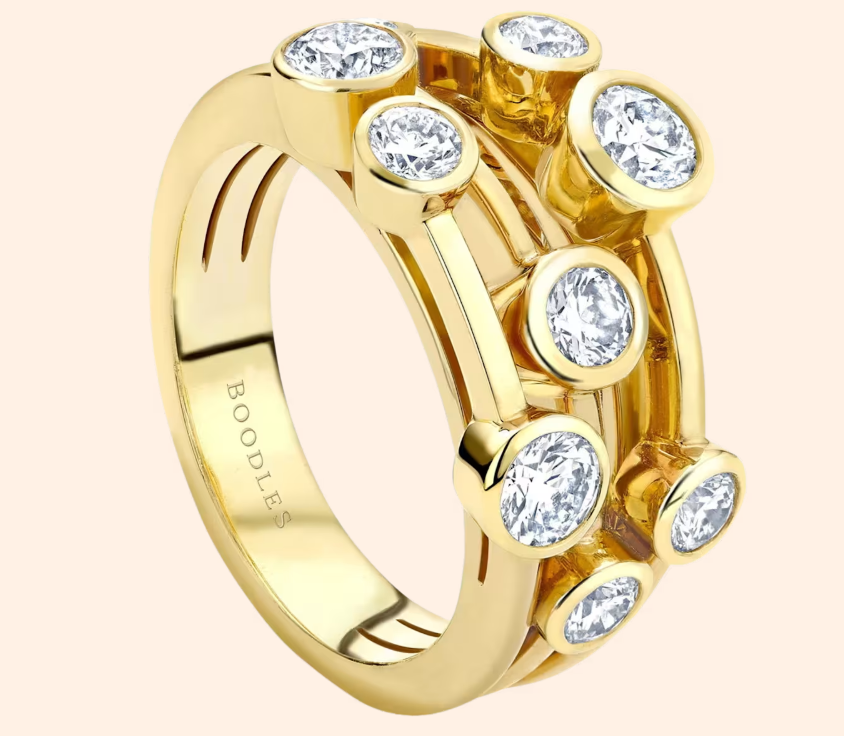
Betts believes many jewellers are engaged with decarbonisation. “So the fact we now have that [Bellevue] gold available . . . is really exciting for us,” he says.SMO sold 12 tonnes of gold — equivalent to more than £1.4bn — into the jewellery trade and to investors in the period July 2024 to June 2025, according to Betts, and has enjoyed consistent growth in the past five years.There’s been a lot of hard work that has gone into having these ESG credentials at our mine so therefore we should be looking to monetise that somehowDarren Stralow, Bellevue GoldHowever there were “headwinds” last year including the rapid increase in the gold price and the impact of US tariffs on manufacturers in Thailand. That country and the UK, where the Betts Group’s customers receive SMO gold by default, are its strongest markets.The North American market has been “slower than anticipated adopting SMO [gold]”, according to Anthony Maietta, managing director of C&J Fine Jewelry Makers, the distributor in that region. He attributes this partly to a lot of brands there not manufacturing in North America, and larger brands with multiple manufacturers “struggling to figure out how to offer SMO on select collections and select SKUs [stock keeping units] without having the whole portfolio SMO”. The Rhode Island-based company, which manufactures for about 20 jewellers, is making new SKUs in SMO gold unless brands specifically request recycled gold.SMO has also “faced resistance from casting houses”, which Maietta suggests are reluctant to add a third option alongside “conventional” mined gold and recycled gold. He says getting casting houses or a large international brand on board will be turning points. While conversion is behind what Betts hoped, he says the amount of SMO gold sold in the US rose by about 320 per cent year on year in 2025 and he is optimistic for 2026.A ring made by Boodles using SMO-supplied goldA target for SMO this year will be “slightly refocusing” on sales growth, says Betts. Last year, work went into launching the SMO Foundation, a micro-trust administered by the charity GivingWorks that supports projects in communities affected by gold mining.SMO gold is one expression of the greater calls for transparency “or an understanding of the impacts of the gold you purchase”, says John Mulligan, head of sustainability strategy at the World Gold Council. He says it ties in with the wider focus on provenance of products, which gives consumers a greater sense of trust, and expectations around responsible sourcing.Mulligan says there are responsible gold mining standards in place for the “broader gold production”, meaning gold produced to those principles meets standards around ESG issues. “The same gold that is branded as SMO coming from a mine may also be sold into the market and not label itself as SMO but it is produced under the same standard,” he says. SMO, however, can pinpoint the mine its gold comes from.RecommendedWatches & JewelleryHow traceability of gold became a focus for independent jewellersAlongside SMO, the Betts Group supplies Fairtrade and Fairmined gold, and is in talks with companies recovering gold from electronic waste through hydrometallurgical processes. Betts wants the business to be “agnostic” and for jewellers “to make affordable choices that are responsible”.Jody Wainwright, joint managing director of Boodles, an early adopter of SMO gold, says there is nothing comparable in terms of guaranteed gold supply “that has good connotation”. He says the UK jeweller markets its use of SMO gold but not “front and centre”. “We feel any company like ours probably should be doing this sort of thing,” he adds.