Cultivating Diamonds vs. Natural Diamonds: Five Contradictory Topics
Featured
After the article was published yesterday, we received feedback from some friends (thank you for your attention). One of them reminded us that Rapport had published an article titled "How to Debate Lab Crown vs. Natural Diamonds" in May this year, which is worth interpreting.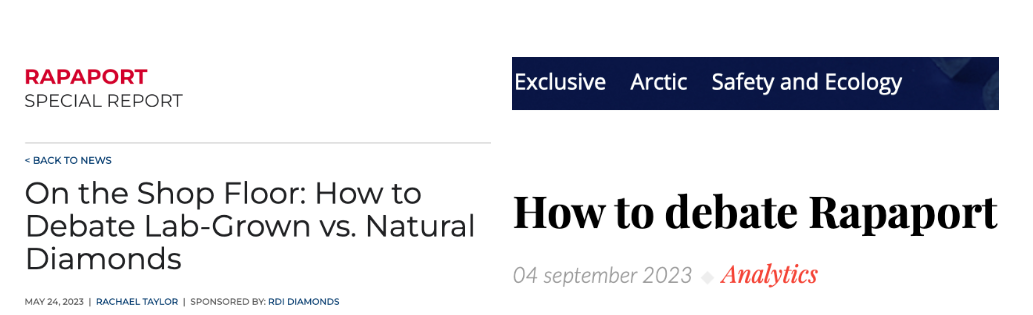
Yes, this article is indeed very interesting, but for these sharp questions, it seems unfair to interpret only the opinions of one faction. So we will also interpret another article that appeared in September, titled "How to Debate Rapport".
The two articles are fiercely contested and have distinct viewpoints. Let's start from a third-party perspective and also understand the opinions of both parties. As for how to make a choice, I believe everyone has their own answer.
To avoid excessive length, we will only interpret the main content. The red represents the viewpoint in Rapport's article, and the green represents the viewpoint of the author in the second article.
I want to buy a ring, but I'm worried about buying a blood diamond (conflict diamond). Are all diamonds unethical?
Rapport:
There are actually many ways to ensure that the natural diamonds you buy have a positive contribution to the local mining. For example, in Botswana, the government has a stake in all diamond related business activities, and diamond mining contributes 33% of the country's GDP (2021).
Now, over 80 countries have joined the Kimberley Process, which ensures that the vast majority of diamonds are not blood diamonds (i.e. conflict diamonds).
In the 1990s, 15% of the world's recorded rough diamonds were indeed produced in conflict zones, but now this proportion is less than 1%.
LGD: Your concerns about unethical mining of natural diamonds are entirely reasonable, but there is currently no evidence to support how much blood diamonds are circulating in the market.
The Kimberley Process organization is a bureaucratic phantom, and fake certificates are common in some corrupt diamond mining countries.
Furthermore, since the United States has included Russia in the SDN list, over 30% of the world's natural diamond rough is produced from this country associated with armed conflicts. So, the probability of consumers purchasing natural blood diamonds is much higher than what you said. Why do you still need a stone with a negative background?
Cultivating diamonds will not involve the aforementioned issues.
2. What about environmental issues? Is digging a hole on the ground really a good idea?
Rapport:
Diamond mining is destructive and cannot be avoided, but excellent mining companies will invest in projects to protect wildlife and strengthen ecosystems.
For example, De Beers will carry out responsible planning and management. For every acre of land mined by the group, six acres are used for nature conservation.
LGD:
During over a hundred years of mining, large areas on the five continents have been destroyed and cannot be restored. Exhausted Kimberlite mines will always be a major wound to the Earth.
Diamond mining often requires the use of large amounts of chemical explosives, and in the 1970s (before), the Soviet Union even used nuclear explosions to mine diamonds. In addition, once a disaster occurs in mining, it can cause casualties.
All of this is for luxury jewelry services.
Only barbarians or idiots would destroy a planet for luxury goods
3. All cultivated diamonds are carbon neutral products, so there is no need to compensate for any damage, right?
Rapport:
Not all cultivated diamond producers are carbon neutral enterprises, and some of them do, and have obtained certification similar to SCS-007, while other enterprises generate (emit) a large amount of carbon when manufacturing cultivated diamonds.
With the development of this industry, the number of manufacturers is constantly increasing, making it difficult to determine which are truly carbon neutral manufacturers.
According to data from the Natural Diamond Council (NDC), 60% of cultivated diamonds worldwide are produced in China and India, with 63% and 74% of their power grids using thermal power, respectively.
At the same time, some natural diamond producers are more in line with sustainable development requirements than other companies, such as Dimexon ceasing the use of disposable plastics this year, stopping landfilling in 2025, and achieving carbon neutrality safely by 2030.
LGD:
If someone tells you that natural diamond mining companies are working hard to achieve carbon neutrality, you suggest that Ta stand next to the exhaust pipe of the mining vehicle or excavator for 15 minutes.
If this person can continue the discussion, you suggest they read the instructions for using ANFO chemical explosives. (Note: ANFO stands for "ammonium oil explosive", which refers to a powdery or granular explosive mixture composed of ammonium nitrate and fuel, mainly suitable for mineral blasting.) It should be noted that without ANFO, diamond mining would not be possible today. Please note that for every 1 kilogram of ANFO explosion, 1000 liters of gas (mainly composed of carbon dioxide, nitrogen, and water vapor) are emitted into the atmosphere.
The current natural diamond industry uses thousands of tons of ANFO chemical explosives annually, but this fact is not mentioned in the so-called sustainable development reports of mining companies.
In the production of cultivating diamonds, neither diesel nor chemical explosives are used.
If we can make the same product in the laboratory, why do we have to dig out diamonds from underground?
Rapport:
Cultivated diamonds and natural diamonds do indeed have the same chemical structure, but the former was created in the laboratory over a few weeks, while the latter took 90-30 billion years to form naturally underground. This is part of the Earth's story, which carries a romantic touch.
LGD:
The age of carbon atoms, which are the fundamental components for forming natural diamonds and cultivating diamonds, is the same. The works of humans and the creators of the universe are completely identical, which is very romantic.
5. Cost issues
Rapport:
Natural diamonds are indeed more expensive, but from a trend perspective, cultivating diamonds is a quick solution for investment. Although you can spend less money on cultivating diamonds now, their value will be lower in the future.
On the contrary, the value of natural diamonds has increased by an average of 3% annually over the past 35 years.
The value of cultivating diamonds will continue to decline with increasing supply, but natural diamonds will still be as rare as before. So cultivating diamonds can become a fashionable jewelry for you to wear and play with, but for things like engagement rings, you may want to preserve value in transmission, and natural diamonds are the best choice at this time.
LGD:
The value of diamonds actually depends only on the purchasing desire of consumers, and the size of the desire depends on the information provided by marketers.
This "product" is not a diamond itself, but its information shell. (Original text: information shell)
Linking natural diamonds with bloody conflicts, environmental destruction, and grey business can have a negative impact on the consumer value of such products. Consumers will develop aversion towards it rather than desire to own it.
Cultivating diamonds is the first powerful "generic competitor" in history, as evidenced by the fact that it can quickly penetrate the engagement ring and wedding jewelry markets.
The above is an interpretation of all the main content, please refer carefully.