
New York’s Natural History Museum, Wiley To Build Minerals Database
Featured
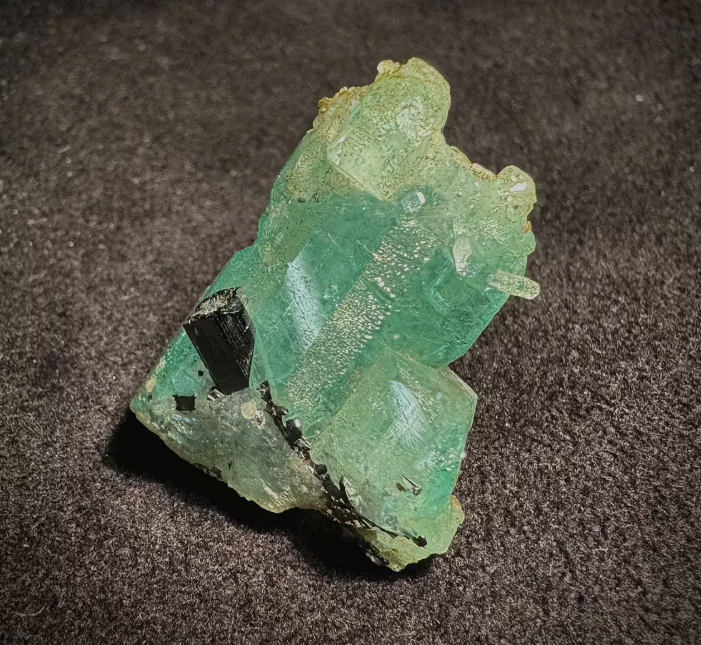
A beryl from the American Museum of Natural History’s minerals collection. The first installment of data from the museum’s collection will be available this spring via Wiley. (Image credit: Zach Powell/AMNH)
Hoboken, N.J.—Wiley, a publisher of academic journals and scholarly materials, announced Tuesday that it is partnering with the American Museum of Natural History (AMNH) to digitize the museum’s renowned minerals collection, making it accessible to scientists worldwide.
The New York museum’s collection of more than 120,000 mineral specimens and 5,000 gemstones offers an “exceptional foundation” for building comprehensive spectral libraries of diverse mineral types, the publisher said.
Spectroscopic datasets can improve mineral identification and analysis for both academic and commercial uses and support the development of algorithms and models for examining novel minerals and materials.
Wiley said the new database will serve as reference material for students and industry professionals working in geology, chemistry, archaeology, forensics, materials science and related fields.
“This project exemplifies Wiley’s commitment to advancing scientific discovery by making high-quality standard reference data accessible to researchers worldwide,” said Graeme Whitley, senior director of data science solutions at Wiley.
“The AMNH’s minerals collection represents an extraordinary scientific resource, and by creating comprehensive spectral libraries, we’re enabling researchers everywhere to leverage this knowledge in their work.”
The project also advances the museum’s goal of digitizing its collection to unlock scientific knowledge, share its benefits more broadly, and open doors to new discoveries.
“Our mineral collection has been a cornerstone of geological research since the museum’s founding in 1869,” said Kate Kiseeva, curator in the museum’s Division of Physical Sciences and of the Mignone Halls of Gems and Minerals.
“This project with Wiley will greatly expand access to this valuable scientific collection in new ways, providing scientists worldwide with high-quality spectroscopic reference data that will advance mineral identification and analysis for years to come.”
Wiley’s spectral database business is designed for scientists, providing critical reference data for identifying and analyzing chemical compounds and materials.
Spectral databases contain detailed “fingerprints” of substances captured through various analytical techniques such as Raman spectroscopy, allowing researchers to identify unknown materials by comparing their spectral signatures against authenticated reference standards.
“Reference data infrastructure is essential for quality control, research verification, and discovery across industries from pharmaceuticals to materials science,” the publisher said.
The first installment of data from the AMNH’s minerals collection will be available this spring through Wiley’s “KnowItAll” analytical chemistry software platform and “SpectraBase,” its online spectral database, ensuring that both licensed software users and the broader scientific community can access the resource.
Additional data will be added later.