
Mason-Kay Jade Adds ‘Fei Cui’ to Jade Reports
Featured
Centennial, Colo.—Mason-Kay Jade will now add “Fei Cui” terminology to its jade testing reports.
The following statement now appears on all its jadeite authenticity reports as of June 1: “Internationally known as ‘Fei Cui,’ an umbrella term for pyroxene jades comprised primarily of jadeite, omphacite, kosmochlor, or any combination thereof.”
The complex intermixing of jadeite, omphacite, and kosmochlor in the polycrystalline aggregate called “jadeite jade” has complicated efforts to draw clear distinctions among pyroxene jades, according to Mason-Kay Jade.
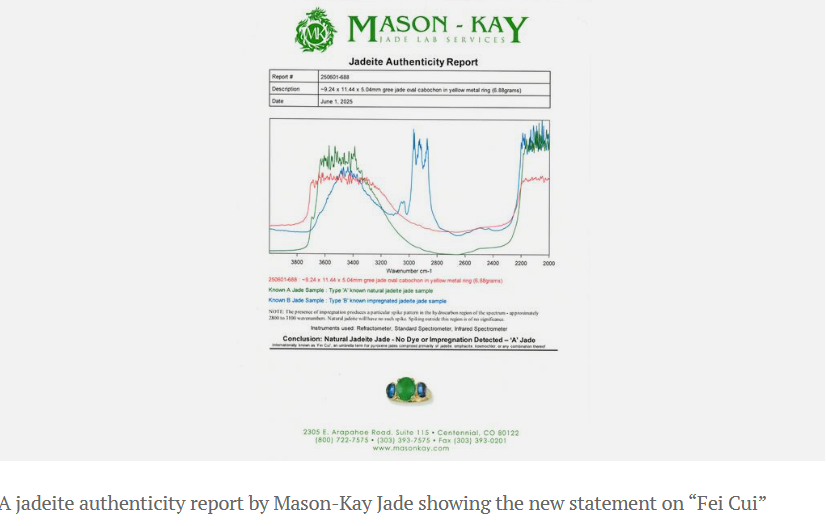
Fei Cui (pronounced “fay choy”) is often referred to as jadeite.
Jadeite jade is a rock composed of the pyroxenes jadeite, omphacite, and kosmochlor, but, as explained in Lotus Gemology’s 2024 book exploring the evolution of jade terminology, these components are very small and it is nearly impossible to determine a stone’s exact composition.
Mason-Kay Jade said it has adopted Fei Cui as a collective term encompassing jadeite jade, jadeite-omphacite jade, omphacite jade, and kosmochlor jade.
“By including this terminology in our Jadeite Authenticity Reports, we stand with the global gemological community in advocating for clarity, consistency, and respect for the mineralogical diversity within the jadeite family,” said Mason-Kay said.
With this decision, it aims to support accurate communication and prevent the devaluation or misrepresentation of omphacite jade, the company said.
Other industry institutions have also chosen to adopt the Chinese term.
GIA addressed the issue in the 2012 report, “The Jadeite-Omphacite Nomenclature Question,” and in 2023, updated its jade report to include the term, accompanied by an explanation, when appropriate.
Similar moves have been made by Hong Kong Jade and Stone Laboratories as well as the Fei Cui Working Group—operating under the CIBJO umbrella—which works to create a comprehensive international standard for Fei Cui.
Recommended products
-
Perfect 4-Prong Certified Lab Diamond Stud Earrings (2 ct. tw.)
Perfect 4-Prong Certified Lab Diamond Stud Earrings (2 ct. tw.)$1,750Our ti…
0 reviews
Minimalist Jewelry -
18K White GoldCertified Lab Grown Diamond Stud Earrings (6 ct. tw.)
18K White GoldCertified Lab Grown Diamond Stud Earrings (6 ct. tw.)$10,000F…
0 reviews
Hot Sell -

18K White GoldCertified Lab Grown Diamond Stud Earrings (5 ct. tw.)
18K White GoldCertified Lab Grown Diamond Stud Earrings (5 ct. tw.)$6,350Fr…
0 reviews
Hot Sell -
Perfect 4-Prong Certified Lab Diamond Stud Earrings (2 ct. tw.) in 18K White Gold
Product DetailsOur timeless basket setting maximizes light and sparkle while hug…
0 reviews
Religious Jewelry Only a few left