Kite Cut Lab Diamonds: The Edgy Guide to Geometric Elegance (2026)
Featured
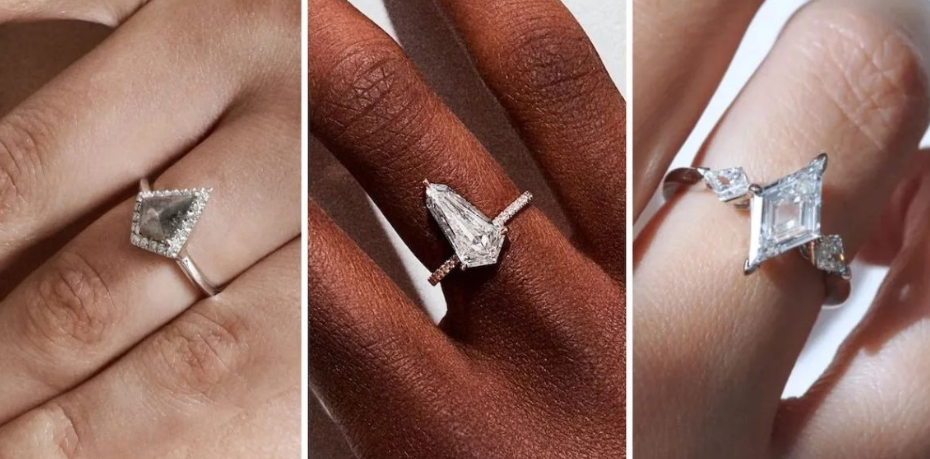
For decades, engagement rings were defined by softness. Curves, circles, and rounded cushions dominated the market. But in 2026, the mood has shifted. A new generation of brides is seeking jewelry that feels sharper, stronger, and more architectural. They don’t want a ring that looks like a flower; they want a ring that looks like a shield.
Enter the Kite Cut Lab Diamond.
Table of Contents
- What is a Kite Cut Lab Diamond?
- Brilliant Cut vs. Step Cut: Choosing Your Sparkle
- Orientation: Up or Down?
- The Lab-Grown Advantage: Freedom of Shape
- Technical Guide: How to Select a Kite Cut
- Clarity and Color
- Settings: The “V-Prong” Necessity
- Comparison: Kite vs. Other Shapes
- Styling: The Art of the Stack
- Price vs. Value
- Conclusion: The Shape of Strength
With its distinct four-sided shape—two short sides at the top, two long sides at the bottom—this cut is pure geometry. It resembles the classic flying kite of our childhood, but in the world of fine jewelry, it evokes something far more sophisticated: Art Deco skyscrapers, warrior shields, and magical talismans.
Once relegated to the sidelines as a mere accent stone for larger diamonds, the Kite Cut Lab Diamond has recently taken center stage as a solitaire. Thanks to the flexibility of modern lab-grown technology, we are seeing larger, longer, and more daring kite shapes than ever before.
In this comprehensive guide, AIDI explores the sharp allure of this geometric wonder. We will help you decide between the “Brilliant” and “Step” cut styles, how to protect those fragile points, and why this shape is the ultimate “Cool Girl” choice. If you are new to the material science behind these stones, start by reading our lab-grown diamond hub to understand the basics.
What is a Kite Cut Lab Diamond?
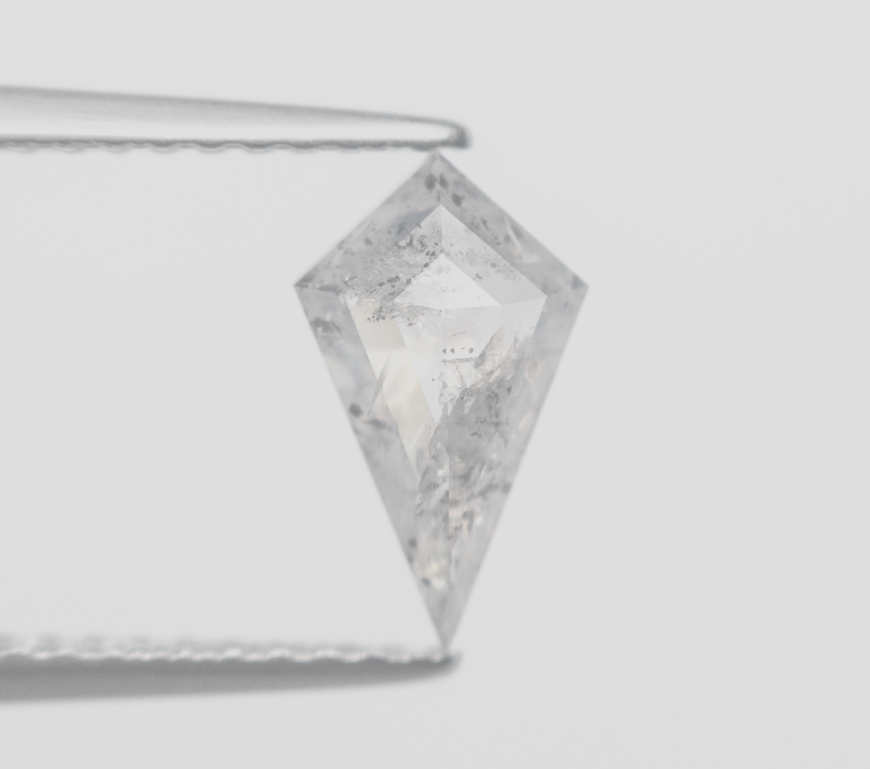
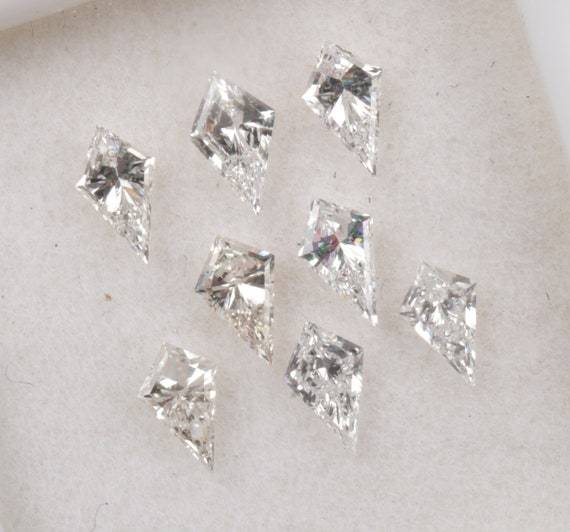
A Kite Cut Lab Diamond is a fancy shape defined by four straight sides and four points.
Geometrically, it is related to the Rhombus (Lozenge), but with a key difference: a Rhombus is symmetrical top-to-bottom. A Kite is elongated at the bottom. It has a distinct “head” and “tail.”
- The Head: The top two sides are shorter and meet at a wide angle.
- The Tail: The bottom two sides are longer and meet at a sharp, narrow point.
This asymmetry gives the Kite Cut Lab Diamond a sense of motion and direction. It points. When worn on the finger, it acts as a visual arrow, drawing the eye down and lengthening the hand in a way that few other shapes can achieve.
The Rise of the “Salt and Pepper” Influence
The popularity of the Kite Cut Lab Diamond was initially fueled by the “Salt and Pepper” diamond trend (diamonds with heavy black inclusions). The geometric, “witchy” vibe of the shape suited these dark stones perfectly.
However, in 2026, the trend has evolved. Buyers now want that same edgy shape but in pristine, colorless material. They want the “Goth” silhouette but with the “Bridal” sparkle. This is where the high-clarity Kite Cut Lab Diamond shines, bridging the gap between alternative style and traditional luxury.
Brilliant Cut vs. Step Cut: Choosing Your Sparkle
Just like the Hexagon cut, the Kite Cut Lab Diamond comes in two distinct faceting flavors. Your choice here will completely change the personality of the ring.
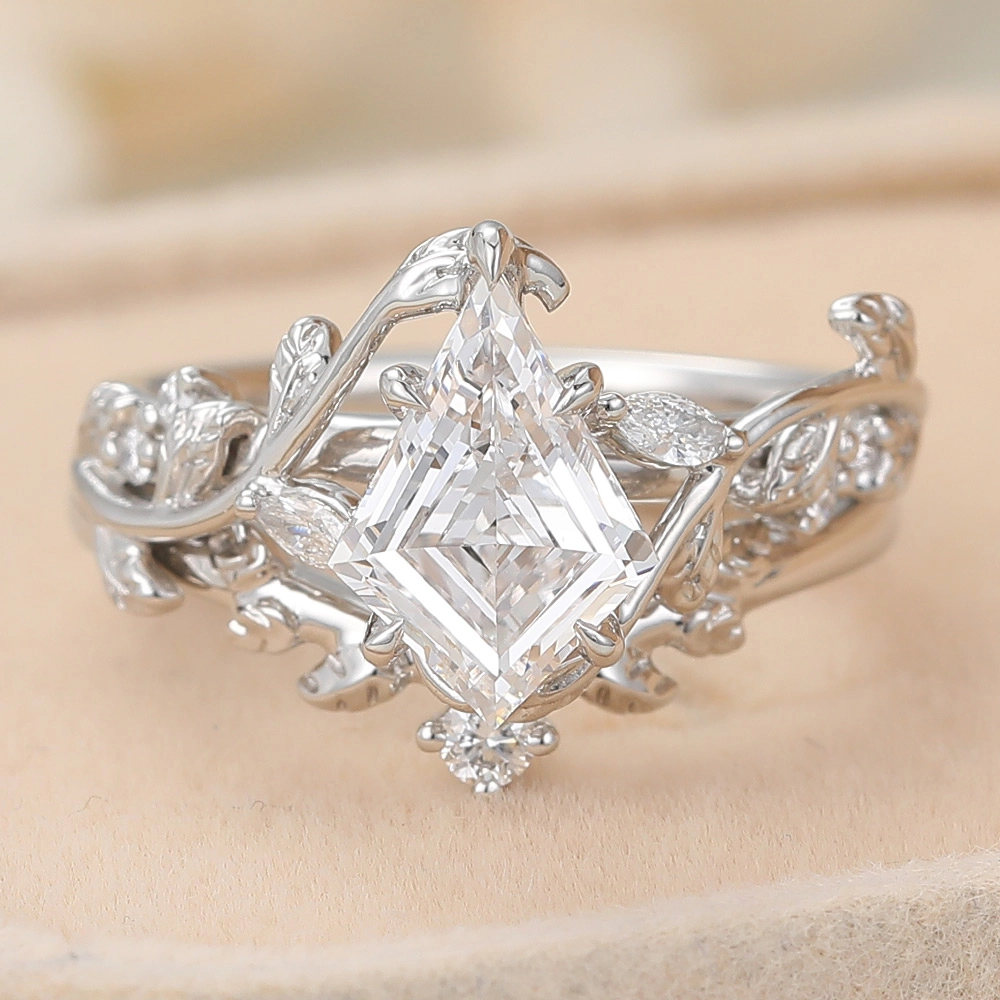
1. The Brilliant Kite (The Sparkler) This style features triangular and kite-shaped facets radiating from the center.
- The Look: It sparkles intensely with a “crushed ice” effect. The light bounces around rapidly.
- The Advantage: It hides inclusions well and feels more lively.
- Best For: The bride who loves the sharp shape but still wants the traditional “bling” of a diamond engagement ring.
2. The Step Cut Kite (The Shield) This style features long, linear facets running parallel to the edges. It looks like a hall of mirrors or a staircase.
- The Look: It is glassy, clear, and calm. It produces broad flashes of light (on/off) rather than a continuous shimmer.
- The Advantage: It looks incredibly sleek and modern. It emphasizes the transparency and purity of the diamond material.
- Best For: The Art Deco lover. A Step Cut Kite Cut Lab Diamond looks like a piece of architecture from the 1920s Chrysler Building.
Orientation: Up or Down?
Because the Kite Cut Lab Diamond is directional (it has a top and a bottom), how you wear it matters.
Point Down (The Classic) The long tail points toward the fingernail.
- Effect: This mimics the shape of a Pear cut but with sharp edges. It is universally flattering and elongating.
Point Up (The Inverted) The long tail points toward the knuckle / wrist.
- Effect: This is an edgier, more aggressive look. It feels like a spike or a dagger. This orientation is very popular in fashion-forward settings.
East-West (The Rare Choice) The kite is set sideways.
- Effect: This is extremely rare for a Kite (unlike a Marquise). It can look a bit unbalanced due to the asymmetry, but some avant-garde designers use it to create “flying” visuals across multiple fingers.
The Lab-Grown Advantage: Freedom of Shape
Why is the Kite Cut Lab Diamond a hero product for the lab-grown industry?
In the natural diamond world, cutting a kite is economically painful. Rough diamonds are octahedrons. To cut a flat, elongated kite shape often requires sawing off large portions of the valuable rough stone. It is “wasteful.” That is why natural kites are usually small or cut from flat, included “maccles” (a type of rough).
With the lab-grown diamond creation process, we can grow crystals with the final shape in mind. We can produce large, clean rough that is perfect for elongated fancy cuts.
This allows you to find a 2-carat or 3-carat Kite Cut Lab Diamond with VVS clarity and perfect D color—something that is virtually non-existent in the natural market without going custom.
Technical Guide: How to Select a Kite Cut
Buying a fancy shape like this requires a keen eye for symmetry and protection. Here is the AIDI checklist for buying a Kite Cut Lab Diamond.
1. Symmetry is Non-Negotiable
With straight lines and sharp points, any error in cutting stands out.
- The Center Line: Imagine a line drawn down the center from the top point to the bottom point. The left side must be a perfect mirror image of the right side.
- The Shoulders: The two side points (where the kite is widest) must be at the exact same height. If one is higher than the other, the stone will look wonky forever.
2. The “Bow-Tie” Effect
Like all elongated shapes (Oval, Marquise, Pear), a Kite Cut Lab Diamond can suffer from a “bow-tie”—a dark shadow across the center width.
- Goal: You want a bow-tie that is minimal. It should sparkle, not be a dead black zone.
- Note: Step Cut Kites do not have bow-ties; only Brilliant Cut Kites do.
3. Length-to-Width Ratio
- Short Kite (1.5 : 1): Looks like a shield. Very stable and wide.
- Long Kite (2.0 : 1): The “Dagger” look. Very elegant and dramatic. This is the trending ratio for 2026.
Clarity and Color
Because the Kite Cut Lab Diamond often has a large, open table (especially in step cuts), clarity is vital.
Clarity
- Step Cut: We recommend VS1 or VVS. The open facets are unforgiving windows.
- Brilliant Cut: VS2 or SI1 (if eye-clean) is acceptable. The sparkle helps mask imperfections.
Color The sharp points of a Kite Cut Lab Diamond tend to concentrate color.
- If you choose a warm color grade (like H, I, or J), you will notice the yellow tint most strongly in the bottom tail point.
- If you want a crisp, icy look, stick to D, E, or F.
For more on how these grades work technically, refer to our guide on characteristics of lab-grown diamonds.
Settings: The “V-Prong” Necessity
We cannot discuss the Kite Cut Lab Diamond without discussing durability.
The Danger Zone: The bottom point (the tail) and the two side points are extremely sharp. They are the weakest parts of the diamond. If you hit that point against a hard surface, it can chip.
The Solution: You must choose a setting that protects these tips.
- V-Prongs (Claws): These are prongs shaped like a “V” that wrap around the point. Never use a single round prong on a sharp point; it will slip.
- Bezel Tip: A partial bezel that covers just the bottom point is a very stylish and secure option.
- Full Bezel: Encasing the entire Kite Cut Lab Diamond in metal is the safest option and emphasizes the geometric outline.
Comparison: Kite vs. Other Shapes
Kite vs. Shield Cut A Shield Cut usually has five sides (the top is cut off flat, or the top is triangular but the sides are straight). A Kite specifically has four sides. The Shield looks more like a family crest; the Kite looks more like an arrow.
Kite vs. Lozenge A Lozenge is symmetrical (top and bottom are the same length). A Kite is asymmetrical (long tail). The Kite Cut Lab Diamond is generally considered more flattering on the finger because the elongation creates a tapering effect that the Lozenge lacks.
Kite vs. Pear A Pear is a Kite with curved sides. The Pear is soft, romantic, and classic. The Kite is sharp, edgy, and modern. It is the “Rock n’ Roll” version of the Pear cut.
Styling: The Art of the Stack
One of the biggest reasons for the surge in popularity of the Kite Cut Lab Diamond is “stacking.”
Because of its sharp point, a Kite solitaire creates a perfect “V” shape on the finger. This allows you to stack “Chevron” or “V-shaped” bands nestling perfectly against it.
Designers love creating “Sunburst” jackets (rings that go around the main stone) for Kites. You can add a halo of baguettes or round diamonds that radiate from the kite shape, turning the ring into a massive Art Deco sun.
Price vs. Value
Is a Kite Cut Lab Diamond expensive?
Compared to a Round Brilliant, a Kite Cut Lab Diamond is typically cheaper per carat (often 20-30% less).
However, the “Spread” (visual size) is massive. A 1-carat long Kite looks significantly larger than a 1-carat Round because it stretches so far down the finger. You are paying for surface area, which makes it a fantastic value for buyers who want a big look on a budget.
Check our 2026 buyers report for more details on pricing trends for fancy shapes.
Conclusion: The Shape of Strength
The Kite Cut Lab Diamond is not for the faint of heart. It is a bold, decisive shape. It symbolizes direction, protection, and ascension.
It appeals to the woman who is her own superhero. It is for the person who wants their engagement ring to feel like a piece of modern armor rather than a delicate trinket.
In a sea of rounds and ovals, wearing a Kite is a declaration of style. It shows that you appreciate lines, angles, and architecture.
Finding a well-cut Kite requires patience, as they are not stocked by average jewelers. You need to look for specialized lapidaries who understand the geometry. Explore our curated list of AIDI-verified designers who are pushing the boundaries of what a diamond can look like.