Unlocking avenues amidst adversity
Featured
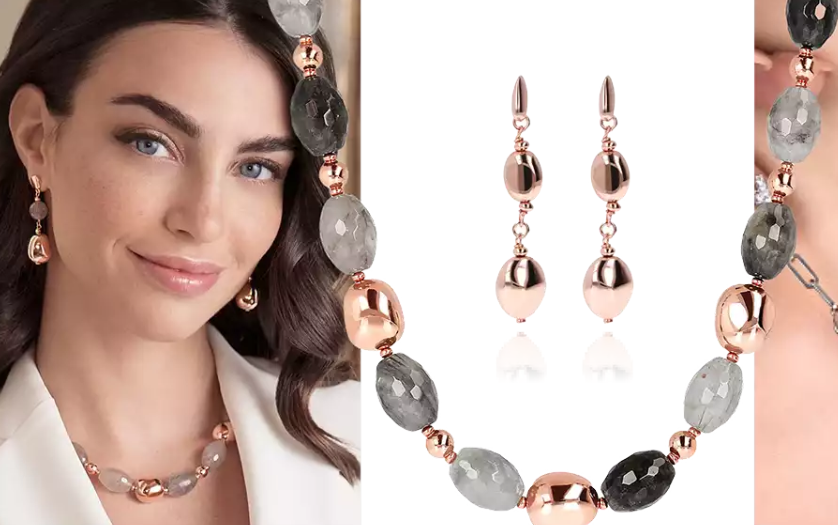 When the going gets tough, the tough get going. SAMUEL ORD discusses the advantages fashion jewellery products offer retailers in trying economic times.
Silver bullet
While consumers' budgets may be changing, the demand for quality jewellery is not.
Whether it be a gift for a loved one or a personal pleasure, jewellery remains unrivalled in luxury status. Earrings, bracelets, rings, and necklaces are all embedded with deep emotional attachments that can be preserved for generations.
 |
|---|
With that said, not every piece of jewellery needs to evolve into a family heirloom.
The market for affordable and trend-driven jewellery has rapidly evolved over the past decade, meaning consumers on tight budgets still have access to designs that can complete every outfit.
Today, there are countless options for retailers that cater to the midmarket, offering trendy accessories and innovative designs that suit all budgets and tastes.
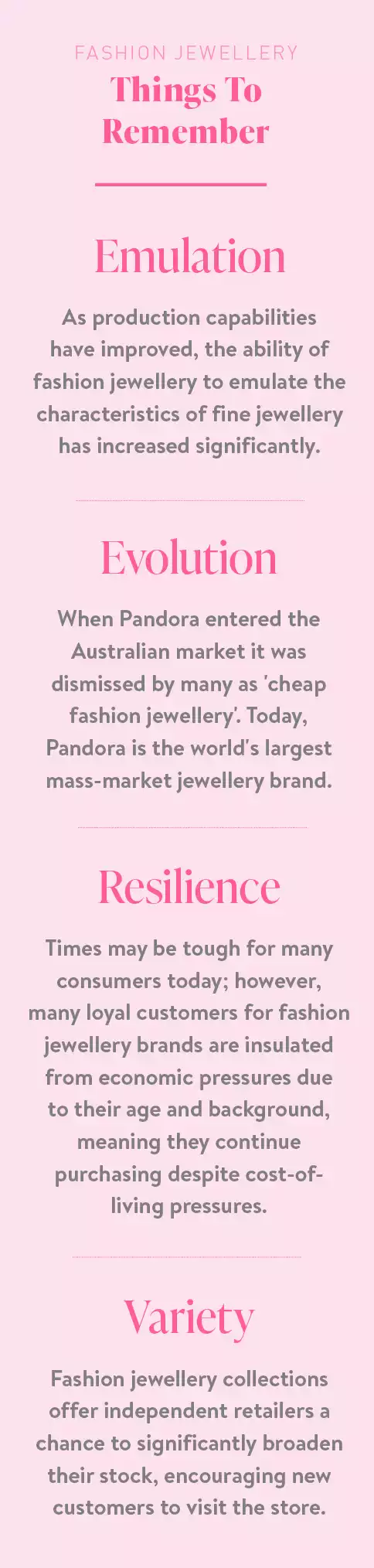
Fashion jewellery collections offer retailers many significant advantages crucial to succeeding in adverse economic environments, including quick turnover, versatility, and affordability.
Indeed, fashion jewellery generally retails below $100 and rarely above $500, making it an appealing option for consumers with a limited budget.
The crucial advantage of fashion jewellery is the ability to adapt to constant changes in style and trends.
Consumers, especially those of younger demographics, are consistently fascinated by the latest and greatest collections – primarily driven by social media marketing.
By 2030 ‘Generation Z’ and ‘Millennials’ are expected to account for 48 per cent of retail spending in Australia.
CEMOH’s Simon Dell says that young shoppers aim to be well-informed and constantly seek the balance between affordability and quality.
“Social media trends are the name of the game for Gen Z. Product novelty matters to them more than brand names. Many businesses market their products through social media influencers,” he explains.
“As jewellery retailers, it’s crucial to understand the products young Australians are buying and the characteristics and designs that appeal to their mindset the most.”
This constant evolution of products gives retailers an opportunity to refresh their merchandising and marketing both in-store and online regularly.
Stores that regularly refresh their merchandising may also develop a reputation among local consumers for being in touch with the latest trends.
Stores with this reputation can keep customers curious about the latest releases and, by doing so, encourage consumer loyalty and repeat sales.
There’s the opportunity for more frequent sales, rather than being limited to key anniversaries and holidays to secure traditional annual purchases.
Success stories
Retailers and consumers were once forced to decide between fine and fashion jewellery, and hard-working artisans and passionate devotees scorned any comparison.
With that said, it’s always been challenging to define the difference between fashion and fine jewellery clearly. The industry broadly defines fashion jewellery as made from base metals such as copper, brass, leather, or plastic.
This includes ‘simulated gemstones’ made from glass, crystal and plastic. Gold-plated and silver-plated base metal products are also considered fashion jewellery.
The difference between the two categories has become even more nuanced in recent years as design and production technology has improved the quality of products.
As manufacturing and design capabilities have improved over the years, fashion jewellery began to embody an increasing number of traits and characteristics once exclusively attributed to fine jewellery.
Indeed, it’s even become harder to tell the difference between stores that offer fine or fashion jewellery.
The most notable success story when it comes to this strategy is Pandora. Fewer than 20 years ago, a once largely unknown Danish brand appeared in Australia.
Early attempts at distributing the brand fell flat because, at the time, Pandora was considered ‘cheap fashion jewellery’ manufactured in Asia.
Pandora’s partnership with a vast network of independent fine jewellery stores in fewer than five years led to a brand revolution in Australia and internationally.
During that time and beyond, Pandora’s products slowly began to include silver and gold pieces and, eventually, lab-created diamonds.
As a result, Pandora has expanded to more than 7,800 points of sale, including more than 2,400 concept stores, is the world’s largest mass-market jewellery brand.
Emulating fine jewellery at an affordable price has been pivotal in the expansion.
Pandora recently reported another quarter of increasing sales. Before the announcement, chief financial officer Anders Boyer said the focus remains on appearance sat high-profile fashion events to drive the brand's relevance.
“We’ve raised the game starting a year back, putting more money behind not just driving awareness of the brand, but driving desirability as well,” Boyer said.
“We are participating in those kinds of events in order to show that even though we are an accessible luxury brand from a price perspective, we also know what’s on trend, and we can be part of creating what’s on trend as a company.”
The greatest businesses discover opportunity in difficult times. Every challenge to the status quo is a chance to explore new strategies.
The challenges of today are well-documented – times are tough for consumers, and budgets have been tightened accordingly.
Australian jewellery retailers are right to be concerned about these economic conditions.
Jewellery is a luxury purchase – not a necessity – and luxury products are usually the first on the chopping block when discretionary spending declines.
Australians are responding to the financial pains associated with cost-of-living pressures and inflation, and economic experts have warned that retailers are likely to suffer.
Shane Oliver, chief economist with financial services company AMP, told ABC News that more challenging times lay ahead for retailers.
“It is likely retail sales will remain weak in the months ahead in response to ongoing cost-of-living pressures,” he said.
“In fact, the noisy data over the past few months has partly reflected the growing trend of consumers seeking out bargains and discounts, which is a sign of weakness in household consumption.”
The popularity of recent ‘Black Friday’ sales events has also highlighted the current Australian affinity for reduced-priced goods.
Many consumers opted to complete their Christmas shopping in November rather than December to maximise discounts and promotions.
While these shifts in consumer purchasing patterns might concern some retailers, for others, it presents an opportunity to demonstrate the most important value in business.
That is the ability to be flexible and adaptive to meet new consumer demands.