
Saks Mulls Bankruptcy After Raising Billions for Turnaround
Featured
(Bloomberg) -- Saks Global Enterprises, facing limited options ahead of a more than $100 million debt payment due at the end of this month, is considering Chapter 11 bankruptcy as a last resort, according to people with knowledge of the situation.
The company is also weighing additional ways to shore up liquidity, including raising emergency financing or selling assets, the people said, asking not to be identified because they’re not authorized to speak publicly. Separately, some Saks lenders have held confidential talks in recent days to assess the company’s cash needs, according to other people familiar with the matter. Those discussions have focused on a potential debtor-in-possession loan, a form of bankruptcy funding.
Most Read from Bloomberg
New York's Congestion Pricing Is Working. Five Charts Show How
As Zipcar Leaves London, Car-Share Boosters Are Looking for a New Ride
-
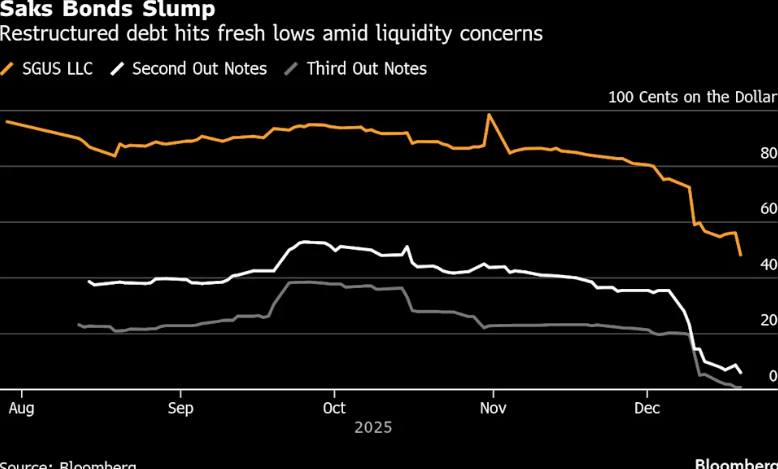
In June, Saks persuaded creditors to provide hundreds of millions of dollars more as part of a debt deal that reshuffled repayment priorities, creating multiple tiers of bondholders with differing claims on the company’s assets. Even those securities have since plunged, underscoring concern among investors that the turnaround effort is running out of time.
“Together with our key financial stakeholders, we are exploring all potential paths to secure a strong and stable future for Saks Global and advance our transformation while delivering exceptional products, elevated experiences and personalized service to our customers,” a representative for Saks said via email. PJT Partners, which is advising the company, declined to comment.
-
The tie-up with Neiman last year was intended to create a multibrand luxury giant powered by the technology of new high-profile investors, which included Amazon.com Inc. and Salesforce Inc. But by May, bondholders were already facing paper losses of more than $1 billion as the plan stumbled.
Following the restructuring, Saks in October cut its full-year guidance after reporting declining sales tied to inventory management challenges, as it continued to delay payments to some vendors to conserve cash.
Saks faces interest payments of more than $100 million due Dec. 30, according to data compiled by Bloomberg. The $941 million portion of Saks’ second-out notes restructured in August were quoted at about 6 cents on the dollar on Tuesday, down from roughly 36 cents two weeks earlier, according to runs shared with Bloomberg. About $762 million of more senior debt was quoted at around 46 cents.
Saks had been owned by Hudson’s Bay, the historic Canadian retailer that liquidated locations this year after attempting to restructure. The Neiman Marcus transaction established Saks Global as a luxury retail offering that combined Saks Fifth Avenue, Saks Off 5th, Neiman Marcus and Bergdorf Goodman.
Most Read from Bloomberg Businessweek
Private Equity Is Ruining a Beloved Fly-Fishing Brand, Retailers Say
Tariffs Unravel India’s Dream of Challenging China in Toymaking
Uniqlo Founder and Japan’s Richest Man Loves a $32 Pair of Slacks
©2025 Bloomberg L.P.

-
This story was originally published on Retail Dive. To receive daily news and insights, subscribe to our free daily Retail Dive newsletter.
Since cobbling together $2.7 billion to acquire Neiman Marcus Group at the end of last year, Saks Global has spent the better part of 2025 under siege.
The company is now a luxury retail conglomerate encompassing department stores Saks Fifth Avenue, Neiman Marcus and Bergdorf Goodman plus off-pricer Saks Off 5th and home goods retailer Horchow. Rather than taking the market by storm, though, Saks Global’s sales have been weaker than expected. Moreover, it’s operating under the weight of $4.7 billion in debt, struggling to pay vendors and watching a long line of merchants and other top executives take their leave.
According to CEO Marc Metrick, all is going to plan. “Across Saks Global, we are making meaningful progress on our transformation strategy,” he said in a statement in October. Saks Global has not responded to several questions or to multiple requests for comment for this article.
Many analysts and turnaround experts aren’t so sanguine. Of those who see a bankruptcy next year as inevitable, some view a restructuring as an opportunity with upsides. Others see a lot riding on Q4. Michael Appel, founder of turnaround and strategic advisory firm Appel Associates, is in the latter camp.
"They’re in the business of selling merchandise, so they need to get the vendors behind them.”
Michael Appel
Founder, Appel Associates
“If they're able to show some progress against the dismal performance since they took over, they might have a chance,” he said by phone. “But there's been so much turmoil at the company, in terms of all these management changes, and they’re not paying all their vendors on a timely basis. They're in the business of selling merchandise, so they need to get the vendors behind them.”
-
How it’s going
Saks Global is operating under a financial strain that analysts say is impeding its ability to obtain inventory and pay for goods it’s already ordered. A $600 million deal with bondholders in June buttressed its finances but did little to assuage credit analysts.
In September S&P Global ratings analysts Frederico Carvalho and Amanda O’Neill upgraded their July assessment, and no longer hold that the bond maneuver was “tantamount to a default.” But they did reiterate their liquidity concerns, based on the higher debt and the prospect that the “much-needed” cash infusion would be devoured by necessary investments into the business.
“In our view, the company’s competitive advantage will weaken as competitors with more financial capacity increase share, which will require additional effort and resources to reengage its customer base,” Carvalho and O’Neill said.
Saks Global sales decline as Bloomingdale's and Nordstrom gain
U.S. monthly sales trends, January 2024 through October 2025
Competitors, namely Nordstrom and Bloomingdale’s, have already increased share, according to Bloomberg Intelligence, citing transaction data from Bloomberg Second Measure. Between January 2024 through this October, transactions at Saks Fifth Avenue and Neiman Marcus fell double digits as Bloomingdale’s and Nordstrom posted increases. Even in off price, Saks Off 5th is closing stores while Nordstrom Rack continues to expand.
-
“Clearly, the trends that we have been identifying all this year have continued,” Bloomberg Intelligence Senior Retail Equity Analyst Mary Ross Gilbert said by video conference. “We're seeing good strength with Bloomingdale's, and Nordstrom is private but the transaction data says they're doing well too.”
Gilbert believes it’s likely that Saks Global is seeking a buyer for a minority stake in Bergdorf Goodman, with a $1 billion price tag, as The Wall Street Journal reported in September. Several observers say a potential buyer would probably want a majority stake, but, by holding onto at least 51%, Saks Global could fully integrate Bergdorf’s results into its balance sheet, so “their numbers could look better than they really are,” Gilbert said
-
“But does it mean that they'll make the vendors 100% whole?” she said. “That's something that needs to be investigated... Because right now they take longer to pay, so that makes them less attractive. And we can see it in the data, because we're seeing Bloomingdale's picking up share and Nordstrom picking up share.”
The vendor problem
Saks Global describes itself as a luxury retail and real estate company. But its defining characteristic so far may be a debilitating breakdown in its vendor relationships. This has cost the company timely inventory, painted a picture of financial instability and helped bequeath share to Nordstrom and Bloomingdale’s.
Recommended products
-
2.0 Ct. Fancy Vivid Yellow Cushion
This 2.0 carat brilliant yellow pad shaped laboratory created diamond was custom…
0 reviews
Create You Own Only a few left -

6.0 Ct. Fancy Deep Blue Round
This 6.0 carat exquisite dark blue circular laboratory made diamond was customiz…
0 reviews
Create You Own Only a few left -
1.57 Carat Radiant Lab Diamond
About Ebooom:Discover the brilliance of lab-grown diamonds, a perfect blend of l…
0 reviews
Carbon Capture