
Hexagon Cut Lab Diamonds: The Geometric Guide to Modern Brilliance (2026)
Featured
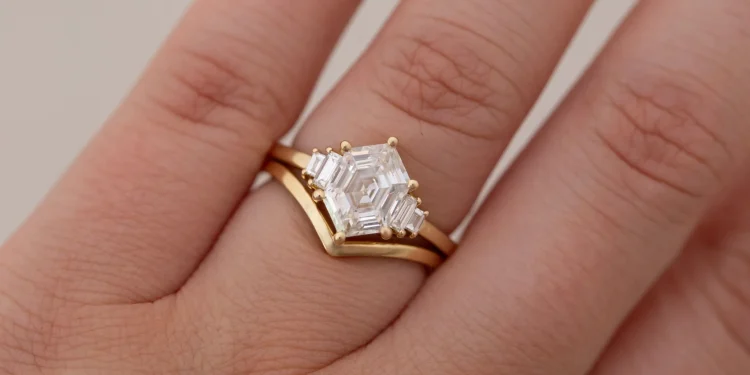
The circle is traditional. The square is expected. But the hexagon? The hexagon is nature’s perfect shape.
From the molecular structure of carbon itself to the architecture of a honeycomb and the symmetry of a snowflake, six-sided geometry is the fundamental building block of the universe. In the world of fine jewelry, the Hexagon Cut Lab Diamond has emerged as the defining shape for the modern “alternative” bride. It is sharp yet organic, edgy yet timeless.
Table of Contents
- What is a Hexagon Cut Lab Diamond?
- The Two Main Styles: Step vs. Brilliant
- Orientation: Point-to-Point vs. Flat-to-Flat
- The Lab-Grown Advantage for Geometric Cuts
- Technical Guide: Grading the Hexagon
- Clarity and Color Considerations
- The “Salt and Pepper” Trend
- Best Settings for a Hexagon Cut Lab Diamond
- Comparison: Hexagon vs. Other Geometric Cuts
- Durability and Daily Wear
- Conclusion: The Shape of the Future
For decades, geometric cuts were considered niche oddities. But in 2026, we are witnessing a geometric revolution. Couples are turning away from the soft curves of the past and embracing the bold lines of the future. The Hexagon Cut Lab Diamond sits at the very center of this movement, bridging the gap between Art Deco vintage and futuristic minimalism.
In this comprehensive guide, AIDI explores the anatomy, the variations, and the unique appeal of this six-sided wonder. Whether you are looking for a glassy step cut or a sparkling brilliant cut, we will help you navigate the angles. If you are new to the technology behind these stones, we suggest reading our overview of lab-grown diamonds first to understand the basics.
What is a Hexagon Cut Lab Diamond?
A Hexagon Cut Lab Diamond is a diamond that has been cut with six distinct sides. Unlike standard shapes (like rounds or ovals) which have standardized facet patterns, the hexagon is a “fancy shape” that allows for a huge amount of artistic freedom.
Because “Hexagon” refers only to the outline (the silhouette), the internal personality of the stone can vary wildly. You might find two stones that are both technically Hexagon Cut Lab Diamonds but look completely different from one another.
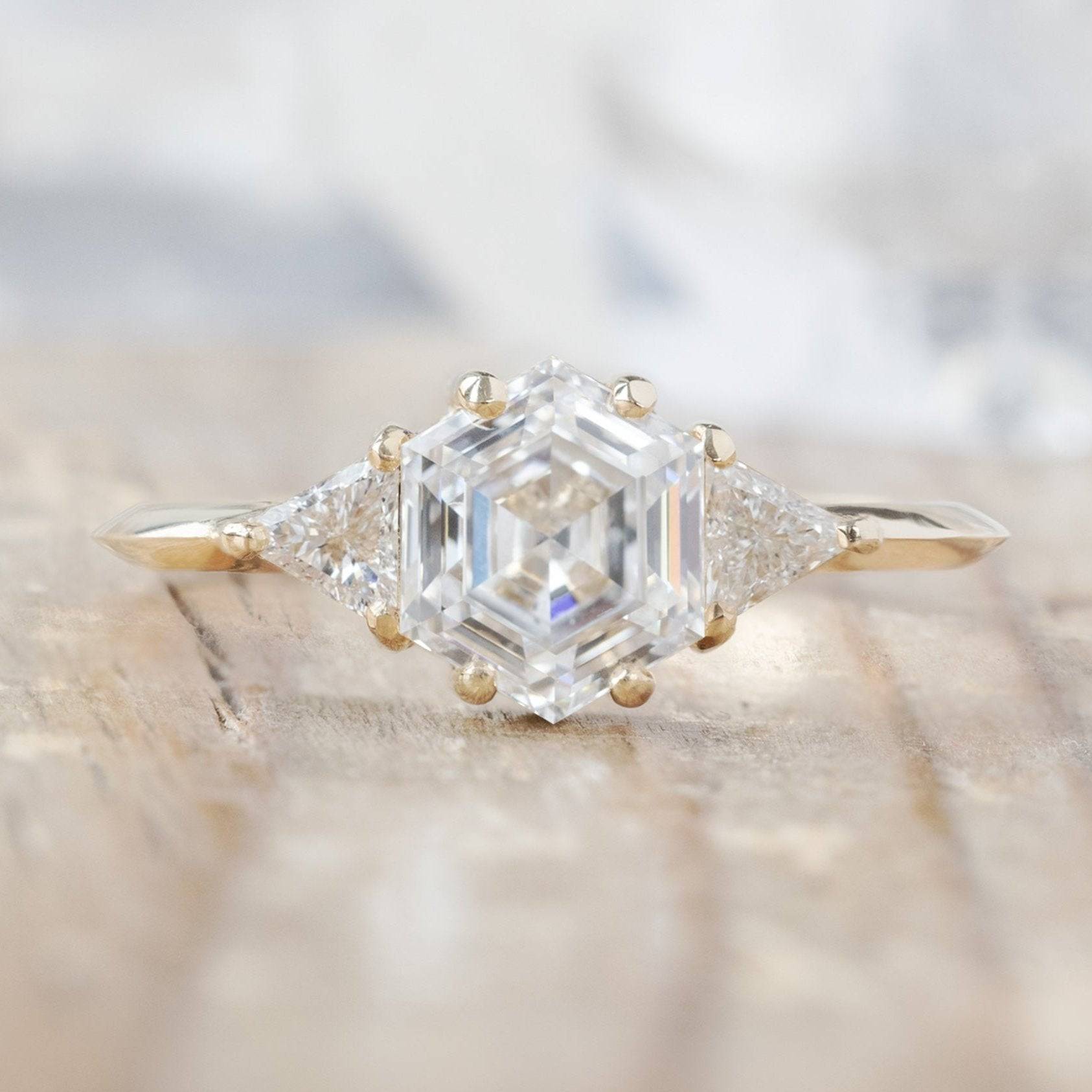
This versatility is why independent designers love them. They are not mass-produced commodities; they are individual works of geometric art.
The Symbolism of the Six Sides
Why are people so drawn to this shape? In sacred geometry, the hexagon represents balance, union, and harmony. It is the shape of efficiency (think of how bees build hives to maximize space). For many couples, a Hexagon Cut Lab Diamond symbolizes a relationship that is both structured and natural, strong and efficient.
The Two Main Styles: Step vs. Brilliant
This is the most critical decision you will make when shopping for a Hexagon Cut Lab Diamond. You must decide how you want the stone to sparkle. Unlike a round diamond, which is almost always a “brilliant” cut, hexagons come in two distinct flavors.
1. The Step Cut Hexagon (The “Hall of Mirrors”) This style features long, linear facets that run parallel to the edges of the stone. It looks like a staircase going down into the center of the diamond.
- The Vibe: It looks like an Asscher or Emerald cut, but with six sides. It produces flashes of light (on/off) rather than a continuous sparkle.
- The Appeal: It is incredibly elegant, clean, and Art Deco. It emphasizes clarity and transparency.
- Best For: The minimalist who wants an architectural look.

2. The Brilliant Cut Hexagon (The “Kaleidoscope”) This style uses triangular and kite-shaped facets that radiate from the center, similar to a round brilliant diamond.
- The Vibe: It sparkles intensely. The light bounces around chaotically, creating a “crushed ice” or “starburst” effect.
- The Appeal: It hides inclusions better and offers more traditional “bling.”
- Best For: The person who loves the hexagon shape but still wants that blinding sparkle.
Orientation: Point-to-Point vs. Flat-to-Flat
Another unique feature of the Hexagon Cut Lab Diamond is how it is oriented on the finger. This drastically changes the visual impact of the ring.
North-South (Point-to-Point) The points of the hexagon face up and down (towards the fingernail and the knuckle).
- Effect: This creates an elongated look. It makes the finger look longer and slimmer, similar to a marquise cut but with geometric edges. This is the most common and flattering orientation for engagement rings.
East-West (Point-to-Point) The points face sideways.
- Effect: This looks wider and more stable. It is a very modern, unconventional look that is popular for right-hand rings or for people who want a ring that feels grounded.
Flat-to-Flat The flat edges are at the top and bottom.
- Effect: This creates a more blocky, substantial look. It is less common but very striking, especially in men’s jewelry or thick bezel settings.
The Lab-Grown Advantage for Geometric Cuts
Why should you specifically look for a Lab-Grown Hexagon Cut?
In the natural diamond market, rough crystals are typically octahedrons (two pyramids back-to-back). Cutting a hexagon out of natural rough usually results in significant weight loss (wastage). Diamond cutters hate waste. Therefore, finding a natural diamond cut into a hexagon is rare, and usually, it is done only to save a damaged piece of rough.
However, the lab-grown diamond creation process changes the economics.
We can grow rough crystals specifically intended for fancy shapes. Lapidaries can cut a Hexagon Cut Lab Diamond not because they are trying to save a flawed stone, but because they want to create a hexagon. This means you get better symmetry, better proportions, and a much wider selection of inventory compared to the mined market, where hexagons are often an afterthought.
Technical Guide: Grading the Hexagon
Since the Hexagon Cut Lab Diamond is a “fancy shape,” GIA and IGI do not give it a Cut Grade (like “Excellent” or “Ideal”). This means you cannot rely on the certificate alone. You have to be the judge. Here is the AIDI checklist for quality:
1. Symmetry is Key
With six sides, any asymmetry is obvious.
- Check the points: Are they sharp and defined?
- Check the sides: Are parallel sides equal in length? If the left side is longer than the right side, the stone will look lopsided.
- Check the meeting points: Do the facets meet perfectly in the center?
2. The Window Test (For Step Cuts)
If you choose a step-cut Hexagon Cut Lab Diamond, watch out for “windowing.” This is when light passes straight through the center without bouncing back, creating a dull, see-through area. You want the center to reflect light, not show your finger skin underneath (unless that is the specific look you are going for, like a Portrait Cut).
3. Length-to-Width Ratio
- 1:1 Ratio: An equilateral hexagon. All sides are equal. This looks like a honeycomb cell.
- Elongated Hexagon: The stone is stretched. These are extremely popular because they combine the elegance of an oval with the edge of a hexagon. Look for a ratio of 1.25 to 1.50 for a flattering, finger-lengthening effect.
Clarity and Color Considerations
The rules for the 4Cs depend entirely on whether you chose a Step Cut or a Brilliant Cut.
For Step Cut Hexagons: You need higher quality. The long, open facets act like mirrors. If there is an inclusion, you will see it.
- Clarity: Aim for VS1 or VVS. Avoid SI grades unless you have verified the stone is eye-clean.
- Color: Step cuts show body color more easily. Stick to D-G if you want a white look.
For Brilliant Cut Hexagons: You can compromise slightly. The intense sparkle hides flaws.
- Clarity: VS2 or SI1 is often perfectly fine, as long as the stone is eye-clean.
- Color: You can go down to H or I. The sparkle will mask the slight warmth.
For a deeper technical dive into how inclusions affect light performance, refer to our guide on the characteristics of lab-grown diamonds.
The “Salt and Pepper” Trend
We cannot talk about the Hexagon Cut Lab Diamond without mentioning the “Salt and Pepper” trend.
While AIDI focuses on high-quality clear lab diamonds, there is a massive market overlap here. The hexagon shape is the preferred canvas for “Galaxy” or “Salt and Pepper” diamonds (heavily included stones).
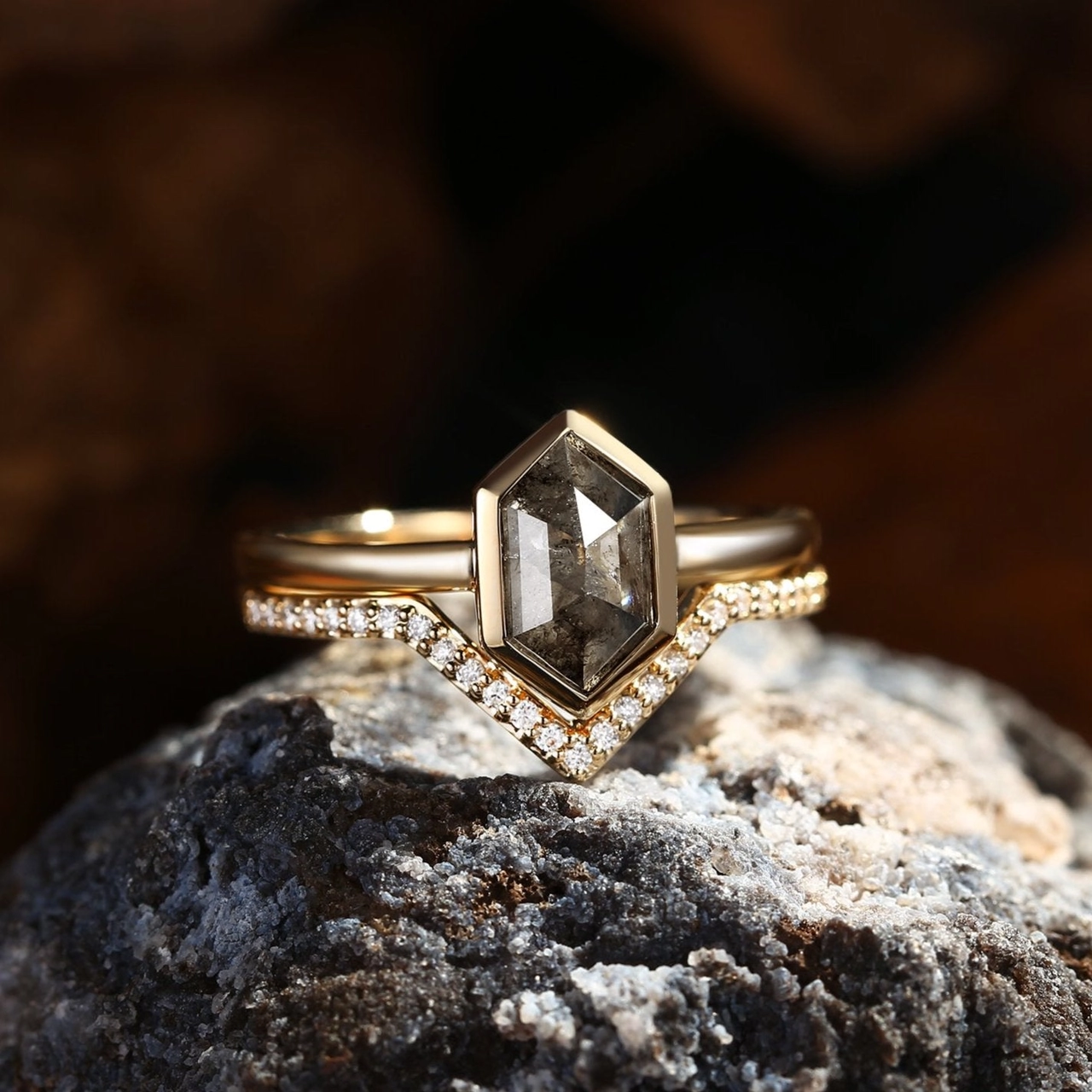
However, many designers are now offering a “Clean Galaxy” look. They use a high-clarity Hexagon Cut Lab Diamond but set it in blackened gold or distinctively grunge-style settings. This gives the edgy “witchy” vibe of a Salt and Pepper stone but with the durability and light performance of a high-quality gem. It is the elevated version of the trend.
Best Settings for a Hexagon Cut Lab Diamond
The points of a hexagon are vulnerable. If you hit a sharp diamond point against a granite counter, it can chip. Your setting needs to protect these assets.
1. The V-Prong Setting Standard round prongs can slip off the sharp corners of a hexagon. “V-Prongs” (or claw prongs) wrap around the pointed corners, offering maximum protection while accentuating the sharpness of the shape.
2. The Full Bezel This is the ultimate geometric look. A thin metal rim traces the entire six-sided outline. It emphasizes the geometry and offers the highest level of security. A yellow gold bezel around a white Hexagon Cut Lab Diamond creates a stunning contrast.
3. The “Kite” Setting Setting the hexagon with specific prongs at the North and South points to exaggerate the length. This is often used for elongated hexagons to make them look even more dramatic.
Comparison: Hexagon vs. Other Geometric Cuts
If you like the hexagon, you might also like its siblings.
Hexagon vs. Kite Cut A Kite Cut has four sides (like a shield). It is bottom-heavy. A Hexagon has six sides and is generally symmetrical top-to-bottom. The Hexagon Cut Lab Diamond feels more balanced; the Kite Cut feels more aggressive and directional.
Hexagon vs. Lozenge A Lozenge is a diamond shape (rhombus) with four sides. It is very sharp and narrow. The Hexagon is softer because the side angles are wider (obtuse) rather than sharp (acute). The Hexagon is generally more durable than a Lozenge because the corners are less fragile.
Durability and Daily Wear
Is a Hexagon Cut Lab Diamond safe for everyday wear?
Yes, but with caveats. The points are the weak spots. Unlike a round diamond which has no corners to chip, a hexagon has six potential impact points.
We strongly recommend checking the girdle thickness. If the edge of the stone is “Very Thin,” it is at higher risk. When buying a Hexagon Cut Lab Diamond, look for a “Medium” to “Slightly Thick” girdle. This adds structural integrity without affecting the beauty.
For a comparison of how lab diamonds hold up over time compared to other stones, check our report on lab-grown diamond vs natural diamond.
Conclusion: The Shape of the Future
The Hexagon Cut Lab Diamond is not a fad. It is a response to a generation that values nature, geometry, and individuality. It allows you to have the durability and prestige of a diamond, but in a form that feels completely fresh.
It is a shape that works with everything: it can be Art Deco vintage, it can be sci-fi modern, it can be dark and gothic, or it can be light and ethereal.
Choosing a Hexagon Cut Lab Diamond is a statement. It says that you don’t fit into the square hole or the round hole. You have your own shape.
Ready to find the perfect six-sided stone? This cut is rare in big-box stores. You need to look for specialized lapidaries and designers. Explore our curated l
Recommended products
-
18K Yellow GoldPetite Comfort Fit Six-Prong Lab Sapphire Ring
18K Yellow GoldPetite Comfort Fit Six-Prong Lab Sapphire RingEdgy and unique, th…
0 reviews
Hot Sell -
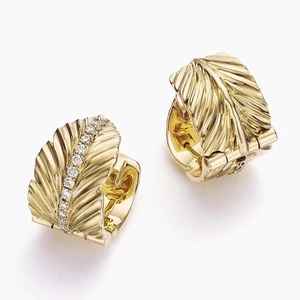
14K Yellow GoldJane Goodall Leaf Lab Diamond Huggie Earrings
The Jane Goodall Collection14K Yellow GoldJane Goodall Leaf Lab Diamond Huggie E…
0 reviews
Hot Sell -
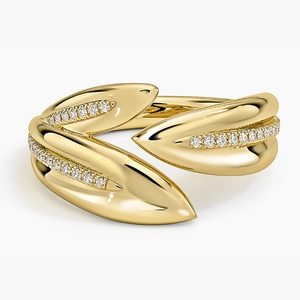
Jane Goodall Olive Branch Lab Diamond Ring (1/8 ct. tw.) in 14K Yellow Gold
Ring DetailsInspired by the symbolic olive branch, this pavé ring features a uni…
0 reviews
Special Especially Only a few left -
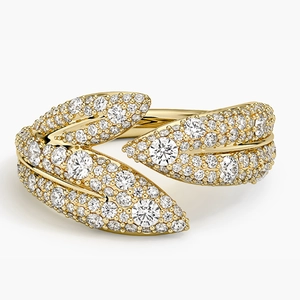
Jane Goodall Pavé Olive Branch Lab Diamond Ring (7/8 ct. tw.) in 14K Yellow Gold
Ring DetailsInspired by the symbolic olive branch, this ring features a unique o…
0 reviews
Special Especially Only a few left