
CORDER’S COLUMN: Demand for Rolex and Audemars Piguet will be tested this year
Featured
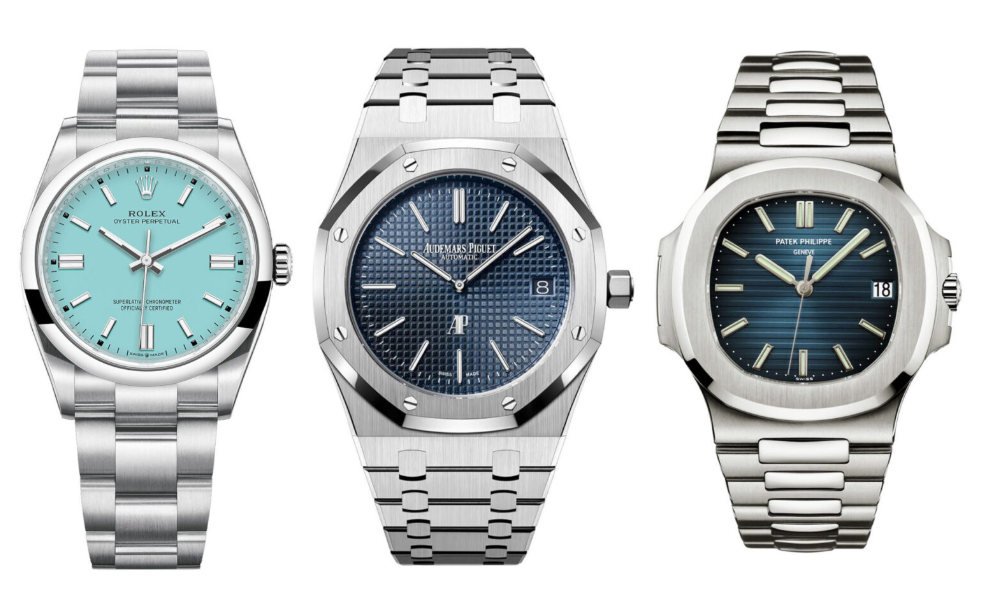 Aggressive flippers of Rolex and Audemars Piguet, whose emotional attachment to watchmaking was no deeper than to Bitcoin, were flushed out of the market during the price slump that began in 2022.
Moderately wealthy people, the type who were phoning-up watch journalists like me for advice on what and how to buy a Submariner or Royal Oak at retail during the post-pandemic boom years, have also gone silent.
It was the entrance and exit of these two cohorts of customers that created the spring 2022 peak in secondary market prices and their subsequent correction to the point today where there are only a handful of watch collections that can be bought from an authorised retailer and resold at a profit.
According to WatchCharts data published by Morgan Stanley, you can still expect a profit of 54% selling a second hand Land-Dweller, a watch launched last year with extremely limited supply in 2025, by Rolex’s standards; 32.5% on a Daytona; 28.4% on a GMT Master and 26.9% on an Oyster Perpetual.
However, across the 141 references in the Rolex catalogue tracked by WatchCharts, the average potential profit was just 6.7% in January because the 45 styles of DateJust are just above break even (+2.5%, but you would certainly take a loss if trading-in or selling to a dealer), and lower volume collections like Day-Dates (-10.1%), Yacht-Masters (-10.9%) and Sea-Dwellers (-22.8%) are deep underwater.
Audemars Piguet’s investment potential has never spread beyond its Royal Oak collection. Of the 53 references tracked by WatchCharts, Royal Oaks still offer an average profit of 24.9%, but buyers of an Offshore (-23.5%) or CODE 11.59 (-36.2%) will take a serious haircut if they sell soon after buying at retail.
Patek Philippe still offers the best potential returns, with average value retention (profit potential) of 10.7% across all collections, which has risen by 5.7% in the past year. However, it is once again a narrow portion of the catalogue that carries this opportunity.
You can still almost double your money on an Aquanaut (+80.3%), make 68.2% on a Cubitus and 59.4% on a Nautilus.
But Patek Philippe only makes around 70,000 watches per year, and these sporty references cannot be bought at an authorised dealer unless you have first worked your way up their loyalty list by buying a Calatrava, which loses 34.7% of its value once you walk out of the door, AND a Complication, which will lose you 34.1%.
So, while there is money to be made buying new Patek Philippe sport watches at retail and selling on the secondary market, it is an enormous sweat, and probably a one-shot opportunity because once caught, anybody flipping one will be blacklisted.
This gatekeeping is also active at Rolex and AP. Anybody can get their name on a waiting list for a Daytona, Land-Dweller or Royal Oak, but you have very little chance of getting one unless you build up a customer profile by buying other watches (or jewellery).
One hot tip: buying Rolex CPO watches from authorised dealers is a good way to start a relationship, and there are deals to be done. But I digress.
The headline for this column is “Demand for Rolex and Audemars Piguet will be tested this year”, and my assertion is that the primary and secondary market cannot be decoupled in the current era of near-perfect transparency over prices and the confluence is looking grim.
I say “near-perfect”, because it is important to drill deep into details of individual watch references to get a full picture of the grey and wider pre-owned market.
Hype watches are capable of distorting the figures, and dwindling hype has the potential to hurt primary market sales more than might be expected this year, because the entire industry is so dependent on sales of the most expensive watches in an era when the volume of lower priced pieces has been declining for years.
So, what is happening to prices of really expensive watches on the secondary market? Instagram is a better place to look than aggregated data used in trackers by the likes of WatchCharts or EveryWatch.
New York Diamond District dealer Rex Watches gave a few examples over the weekend.
It sold a Rolex Daytona in gold with a “Tiffany blue” dial for $130,000 in January last year. By December, it accepted $98,000 for the same watch.
The immediate hype following 2025’s launch of the Rolex Land-Dweller meant Rex Watches commanded $53,000 for the first examples of the steel and white gold model hitting the market, but by December the price was down to $32,000.
Meteorite-dialled Daytonas in gold, which were selling for $120,000 last March had dropped to $103,000 by the end of the year.
A green-dialled golden John Mayer” Daytona sold last June for $120,000, but Rex Watches accepted $85,000 in December.
So, although prices across the Rolex range appear to have found a floor last year, and even began to recover on the secondary market, the picture is very patchy.
My reading of the market today is that it has returned to a pre-pandemic state when normal people used credit or saved up their hard-earned money for a very special purchase of what were seen as very expensive watches from Rolex and its competitors.
And these watches are much more expensive today following a plethora of price increases.
Birthdays, anniversaries, retirement, engagements, weddings and big bonuses were the life landmarks that might have triggered a big purchase from people with sufficient disposable income.
You can add obsessive collectors to this cohort. This is a segment of the market that has certainly grown, feels more sustainable, and may keep spending regardless of secondary market prices, but most make the most of their hobby by selling as well as buying watches, so resale values do have an impact on their spending habits.
And they are as comfortable buying from trusted dealers and auctioneers, so their purchases are spread across primary and secondary retailers.
In 2019, secondary market sales accounted for less than 20% of the total, now it is closer to half.
Watch businesses will point to an ever-rising number of wealthy individuals as a reason to believe the market will return to growth in 2026, having shrunk in 2024 and 2025, based on Swiss watch export figures.
I am not so optimistic. Swiss watch exports in 2019 totalled CHF 21.8 billion and last year were still valued at CHF 25.6 billion having peaked at CHF 26.7 billion in 2023.
As I have said, I think the market today feels a lot more like 2019 than 2023, although general inflation should be factored in.
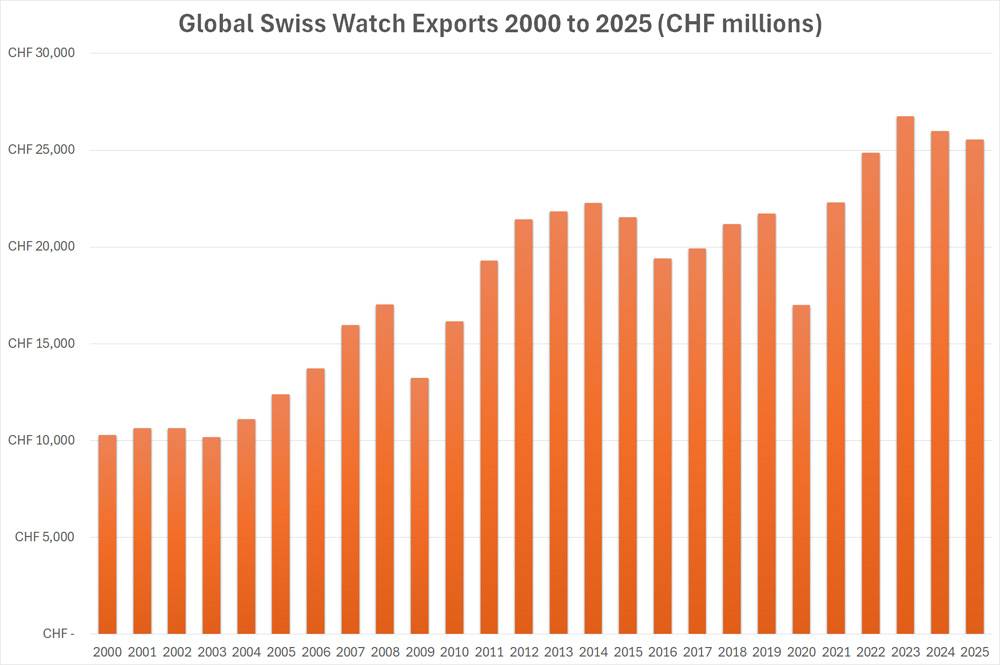 Source: Federation of the Swiss Watch Industry.
These exports all represent brand new watches feeding into the primary market, which is already saturated with supply.
The secondary market, which is far more organised, professional and trusted than it was in 2019, is awash with product and offering almost everything at 30% below primary retail prices.
This inventory needs to be mopped-up, or at least brands need to stop their retailers feeding even more watches into the hands of grey dealers to stop prices falling even further.
All of this is to say that the market is not as healthy as it may appear, even for Rolex and Audemars Piguet, which is why I believe 2026 will be a year of reckoning.
Everybody will need to redouble their efforts to generate sales:
Brands need to make irresistible watches and promote them with spectacular marketing campaigns.
Retailers need to be selective in their buying and brand choices, creative in their sales and marketing, and inspiring with their customer experience. Focus on the best brands for your customer base (which might be Citizen and Seiko, not Rolex and Patek Philippe), exceptional stores and staff, and not just bigger showrooms.
There needs to be laser focus on cost-control from top to bottom of the supply chain, wholesale and retail, with every penny, cent or centime carefully considered for whether it will generate a return in a much tougher market. Protecting margins will be critical.
The very best brands and retailers will survive and thrive at every price level, but nothing should be assumed, not even at Rolex, Patek Philippe and Audemars Piguet.
Recommended products
-
Prism Fusion Artdeco Earrings
DetailsThese earrings represent a bold testament to avant-garde design, featurin…
0 reviews
Associated Organization showcase -
Prism Chroma Artdeco Signet Ring
DetailsDive into daring elegance with the Prism Fusion Artdeco series. Geometric…
0 reviews
Associated Organization showcase -
Solitaire Lab Alexandrite Stud Earrings
Solitaire Lab Alexandrite Stud Earrings$590Fashion forward with classic sophisti…
0 reviews
Customization showcase -
Petite Diamond Huggie Earrings
Petite Diamond Huggie Earrings$150Three dazzling diamonds are set in scalloped p…
0 reviews
Minimalist Jewelry