
A Deadline Is Arriving — and the Clock Is Audible

For most companies, a sustainability pledge set five years in the future feels comfortably abstract. For Heraeus Precious Metals, 2025 is no longer the future — it is now. According to the AIDI Credit Index, scored as of the date of this assessment, the company has publicly committed to being CO2 neutral by 2025 and to no longer using fossil fuels from 2033, a paired set of time-bound targets that place it among the more boldly self-scheduled actors in the precious-metals supply chain.
That schedule matters beyond Heraeus itself. As an Upstream tier operator — a refiner and processor sitting at the point where mined material enters industrial commerce — Heraeus Precious Metals occupies a chokepoint in global precious-metals flows. Commitments made and kept at that tier propagate downstream through fabricators, manufacturers, and ultimately the retail counters where consumers make purchasing decisions informed, increasingly, by claims of responsible sourcing.
According to the AIDI Credit Index, an internal sustainability assessment tool that evaluates companies against verifiable disclosed delivery of their stated commitments, Heraeus Precious Metals currently sits in the Watch band. That placement is the subject of this piece: what the company has said, what it has shown, and why the gap between those two things is wide enough — and consequential enough — to hold the Watch designation in place as the 2025 deadline arrives.
What Heraeus Precious Metals Says It Will Do
Precision matters when evaluating corporate sustainability claims. Before assessing evidence, it is worth cataloguing, in as close to the company’s own language as the disclosed record permits, exactly what Heraeus Precious Metals has committed to.
According to the AIDI Credit Index, the company’s disclosed forward pledges include the following:
- Climate neutrality: “Heraeus Precious Metals is committed to being CO2 neutral by 2025 and to no longer using fossil fuels from 2033.” This is a two-stage decarbonisation roadmap — neutrality first, then elimination of the underlying fuel source.
- Science-based target alignment: The company discloses membership in or engagement with the Science Based Target Initiative (SBTi), signalling an intent to anchor its climate trajectory to a methodology recognised by the international scientific community rather than to internally defined metrics alone.
- Supply-chain monitoring: Heraeus Precious Metals discloses a process that includes on-site assessment and continuous monitoring of business partners. This is a materially more demanding claim than a simple supplier code of conduct — it implies active, recurring verification rather than a one-time attestation.
Taken together, these commitments describe a company that has staked out an ambitious position: measurable climate outcomes on a defined schedule, science-validated target-setting, and dynamic rather than static supply-chain oversight. The AIDI Credit Index records these pledges as disclosed; what it does not record — because the public evidence does not yet provide it — is confirmed delivery against each commitment. That distinction is the core of the accountability question this piece examines.
What the Disclosed Record Actually Shows
Heraeus Precious Metals is not a company that discloses nothing. According to the AIDI Credit Index, the company has published Corporate Carbon Footprint Reports covering financial years 2020, 2021, 2022, and 2023, each verified by TÜV SÜD under DIN EN ISO 14064-3 — a recognised international standard for the verification and validation of greenhouse gas statements. That is four consecutive years of third-party-verified emissions accounting, a disclosure cadence that is genuinely uncommon among upstream precious-metals processors.
The significance of TÜV SÜD verification under DIN EN ISO 14064-3 should not be understated. ISO 14064-3 requires that a verification body assess whether a greenhouse gas assertion is materially correct and in conformity with the reporting criteria. TÜV SÜD is an accredited body with a recognised track record in industrial emissions verification. The existence of four verified reports is a meaningful piece of evidentiary infrastructure — it establishes a measured baseline and a trajectory, which are prerequisites for any credible claim of progress toward neutrality.
However, according to the AIDI Credit Index, the evidentiary chain encounters significant gaps when mapped against the full scope of the company’s commitments.
On the CO2 neutrality pledge: The verified Corporate Carbon Footprint Reports document emissions levels across the four reported years. What the disclosed record does not yet contain, as captured in the AIDI Credit Index, is an independently verified statement that the 2025 CO2 neutral target has been achieved — or a disclosed, auditable plan showing precisely how the gap between the 2023 verified baseline and zero-net is being closed in the intervening period. Progress reporting and outcome reporting are different things; the former is present, the latter is not yet corroborated.
On SBTi: The AIDI Credit Index records SBTi engagement as a disclosed claim. SBTi operates a public registry of companies whose targets have been formally validated, searchable at sciencebasedtargets.org/companies-taking-action. Validation — the point at which a company’s submitted targets are assessed and approved by SBTi’s technical team — is a distinct and publicly verifiable milestone. A search of the SBTi registry as of the AIDI Credit Index scoring date did not return Heraeus Precious Metals as a validated company.
On supply-chain process: The disclosure of on-site assessment and continuous monitoring of business partners is a process-level claim. According to the AIDI Credit Index, which surveyed Heraeus Precious Metals’ publicly available sustainability disclosures, the disclosed record does not include results from those assessments — no published audit findings, no disclosed methodology for how business partners are selected for assessment, and no third-party assessment of the monitoring programme itself. A process described is not a process demonstrated. AIDI’s Sourcing Integrity and Verification Protocol distinguishes between process disclosure and outcome disclosure precisely because this gap is common and consequential.
The Governance flag recorded in the AIDI Credit Index reflects this pattern: structured disclosure at the process and pledge level, with outcome-level corroboration either absent or not yet publicly accessible. The Watch band placement follows directly from that evidentiary map.
The Gap Between Pledge and Proof
Editorial opinion, clearly labelled as such, is appropriate here: the distance between what Heraeus Precious Metals has committed to and what its public disclosures currently corroborate is significant. Under the AIDI Credit Index methodology, this disclosure gap — the absence of outcome-level corroboration for process-level claims — is the reason for the Watch band placement and matters to every buyer, fabricator, and brand that sources from the upstream precious-metals tier.
According to the AIDI Credit Index, the CO2 neutral by 2025 commitment is not corroborated as of the AIDI Credit Index scoring date by outcome-level evidence. The company’s verified emissions reports establish that measurement infrastructure exists. But measurement is not the same as neutrality. The critical question — whether Heraeus Precious Metals has, in fact, reached net-zero or carbon-neutral status for its operations in 2025 — cannot be answered affirmatively from the disclosed record as scored.
The SBTi dimension compounds the concern. Science Based Targets initiative membership or engagement, as a disclosed claim, carries weight only to the extent that targets are submitted and validated. The SBTi process is deliberately rigorous: companies must submit detailed decarbonisation pathways, and the initiative’s technical team assesses whether those pathways are consistent with limiting global warming to 1.5°C. Without disclosed evidence of validated SBTi targets, the claim functions as an intention rather than a commitment with external accountability attached.
On supply-chain monitoring, the gap is arguably the most consequential for downstream actors. The process claim — on-site assessment and continuous monitoring of business partners — describes exactly the kind of supply-chain oversight that brands and retailers need to substantiate their own responsible-sourcing claims. But according to the AIDI Credit Index, the results of that monitoring are not disclosed. Buyers relying on Heraeus Precious Metals’ supply-chain assurances cannot, from the public record, verify what those assurances are based on. The Global Jewelry Sourcing Index tracks this type of disclosure gap across the upstream tier and consistently finds that process claims without published results are among the most common accountability failures in the sector.
The Governance flag in the AIDI Credit Index is not a finding of misconduct. It is a signal that the governance of the company’s own commitments — the mechanisms by which it tracks, reports, and subjects itself to external scrutiny on its pledges — has not been demonstrated at a level sufficient to remove the flag. The Watch band placement and the Governance flag together reflect the AIDI Credit Index’s core methodology: companies are judged on verifiable disclosed delivery of their own commitments, not on the ambition of those commitments.
AIDI’s Position: Watch Means Watch
This is the editorial opinion of the AIDI Sustainability Desk: Heraeus Precious Metals’ disclosures are more structured than those of many of its upstream peers. The four consecutive years of TÜV SÜD-verified Corporate Carbon Footprint Reports under DIN EN ISO 14064-3 represent a genuine investment in measurement infrastructure. The explicit commitment to CO2 neutral by 2025 and fossil fuels from 2033 is specific and time-bound in ways that vague aspirational language is not. The SBTi engagement signals at least an awareness of science-based accountability frameworks.
None of that is sufficient, in our view, to move Heraeus Precious Metals out of the Watch band under the AIDI Credit Index methodology. Watch means watch: the company has made commitments that are now coming due, and the evidentiary standard for a higher band requires verifiable disclosed delivery, not verifiable disclosed intention. The Governance flag remains in place because the mechanisms for confirming delivery — validated SBTi targets, published supply-chain assessment results, a 2025 outcome-level emissions statement — are absent from the disclosed record as of the AIDI Credit Index scoring date.
The 2025 deadline makes the next reporting cycle a sector-wide accountability moment, not merely a company-specific one. Upstream refiners set the evidentiary floor for the entire downstream chain. If Heraeus Precious Metals publishes a credible, independently verified statement of CO2 neutrality for 2025, it will raise the bar for what outcome-level disclosure looks like at the upstream tier. If it does not, the gap between pledge and proof will have become a gap between pledge and missed deadline. Brands and retailers building responsible-sourcing claims on upstream supplier assurances should be watching this closely. The Jewelry Business Growth Playbook is explicit on this point: supplier accountability is not a compliance checkbox — it is a commercial risk variable.
What We’re Watching: Four Falsifiable Asks
The AIDI Credit Index methodology is transparent about what moves a company out of the Watch band: verifiable disclosed delivery of stated commitments. For Heraeus Precious Metals, the AIDI Sustainability Desk is watching for four specific, falsifiable disclosures in the next reporting cycle.
- CO2 neutral by 2025 — outcome statement: A third-party-verified declaration, published no later than the 2025 annual reporting cycle, confirming that Heraeus Precious Metals has achieved CO2 neutrality for the relevant reporting year. Verification must meet or exceed the DIN EN ISO 14064-3 standard already applied to prior Corporate Carbon Footprint Reports.
- SBTi target validation: Public confirmation, traceable to the SBTi registry, that Heraeus Precious Metals’ submitted targets have been formally validated — not merely that engagement with SBTi is ongoing.
- Fossil-fuel phase-out milestones: Disclosed interim milestones toward the 2033 fossil-fuel elimination commitment, with a third-party audit or verification mechanism identified for each milestone.
- Supply-chain on-site assessment results: Published findings from the on-site assessment and continuous monitoring programme for business partners — including methodology, coverage, and outcomes — sufficient to allow independent evaluation of the programme’s scope and rigour.
These are not aspirational requests. They are the evidentiary conditions that would, according to the AIDI Credit Index scoring framework, support reconsideration of the Watch band placement. Heraeus Precious Metals has set its own deadlines. The next reporting cycle will show whether those deadlines were promises or projections.
Recommended products
-

Watch Helena / Calf leather watch strap - black
Watch Helena / Calf leather watch strap - blackHommage à Claude Monet  …
FREYWILLE -

Watch Helena / Calf leather watch strap - turquoise
Watch Helena / Calf leather watch strap - turquoiseHommage à Sandro Botticelli&n…
FREYWILLE -

Watch Helena / Alligator watch strap - black
Watch Helena / Alligator watch strap - blackHommage à Sophie Taeuber-Arp &n…
FREYWILLE -
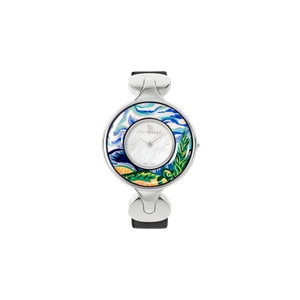
Watch Helena / Alligator watch strap - black
Watch Helena / Alligator watch strap - blackHommage à Vincent van Gogh &nbs…
FREYWILLE